


Tuxedo vs Suit: Key Differences Explained
A tuxedo is a suit with satin on it. That is the whole difference in one line. A tuxedo puts satin or grosgrain on the lapels, the buttons and the outside seam of the trousers, and it is built for evening formal wear. A suit uses the same matte cloth everywhere and works from a Tuesday meeting to a Saturday reception.
- Tuxedo: satin lapels, satin-covered buttons, satin trouser stripe, bow tie, no belt loops, worn for black tie and evening events.
- Suit: self-fabric lapels, plain buttons, no stripe, necktie, belt loops or side adjusters, worn for business, daytime and most weddings.
- Cost: renting formal attire averaged $205 per person in The Knot 2025 Real Weddings Study, while an entry-level suit you own starts near $200.
- Rule of thumb: if the invitation says black tie, wear a tuxedo. Everything else is suit territory.
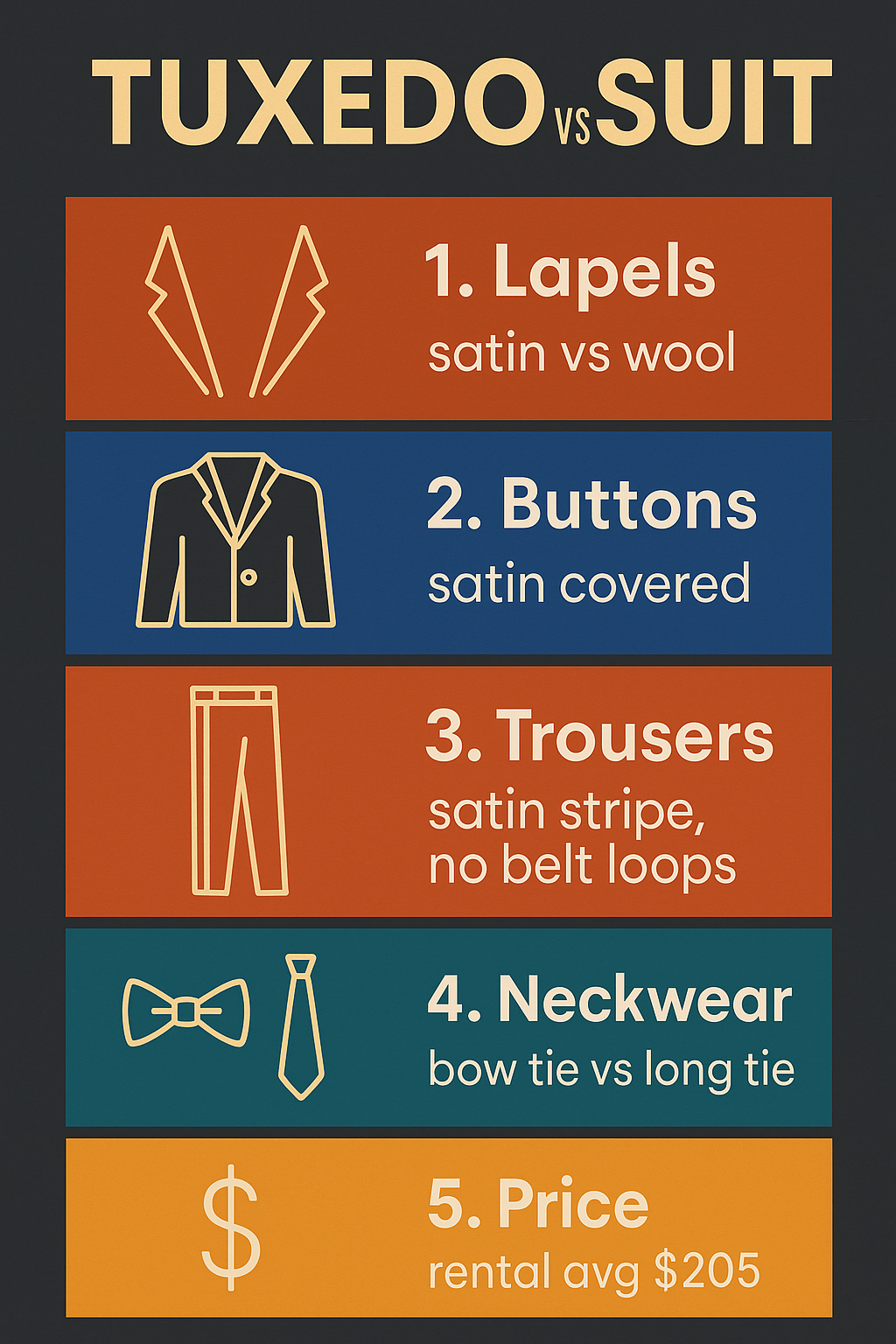
Table of contents
- What is a tuxedo?
- What is a suit?
- Tuxedo vs suit: the key differences
- When to wear a tuxedo
- When to wear a suit
- Tuxedo vs suit for weddings
- Price comparison: what each one really costs
- Tuxedo vs suit vs blazer vs smoking
- How to choose between them
What is a tuxedo?
A tuxedo is the jacket-and-trouser outfit designed for the black tie dress code, identified by satin or grosgrain facings on the lapels, satin-covered buttons and a satin braid running down the outside of each trouser leg. In Britain it is a dinner jacket. In France it is un smoking.
The name is American geography. The garment reached US society through Tuxedo Park, the Gilded Age club colony in Orange County, New York, which opened in 1886 and where, according to the Village of Tuxedo Park, the tailless evening coat made its American debut at a club ball. The English version came first, cut by Savile Row tailor Henry Poole for the Prince of Wales as an informal alternative to tails.
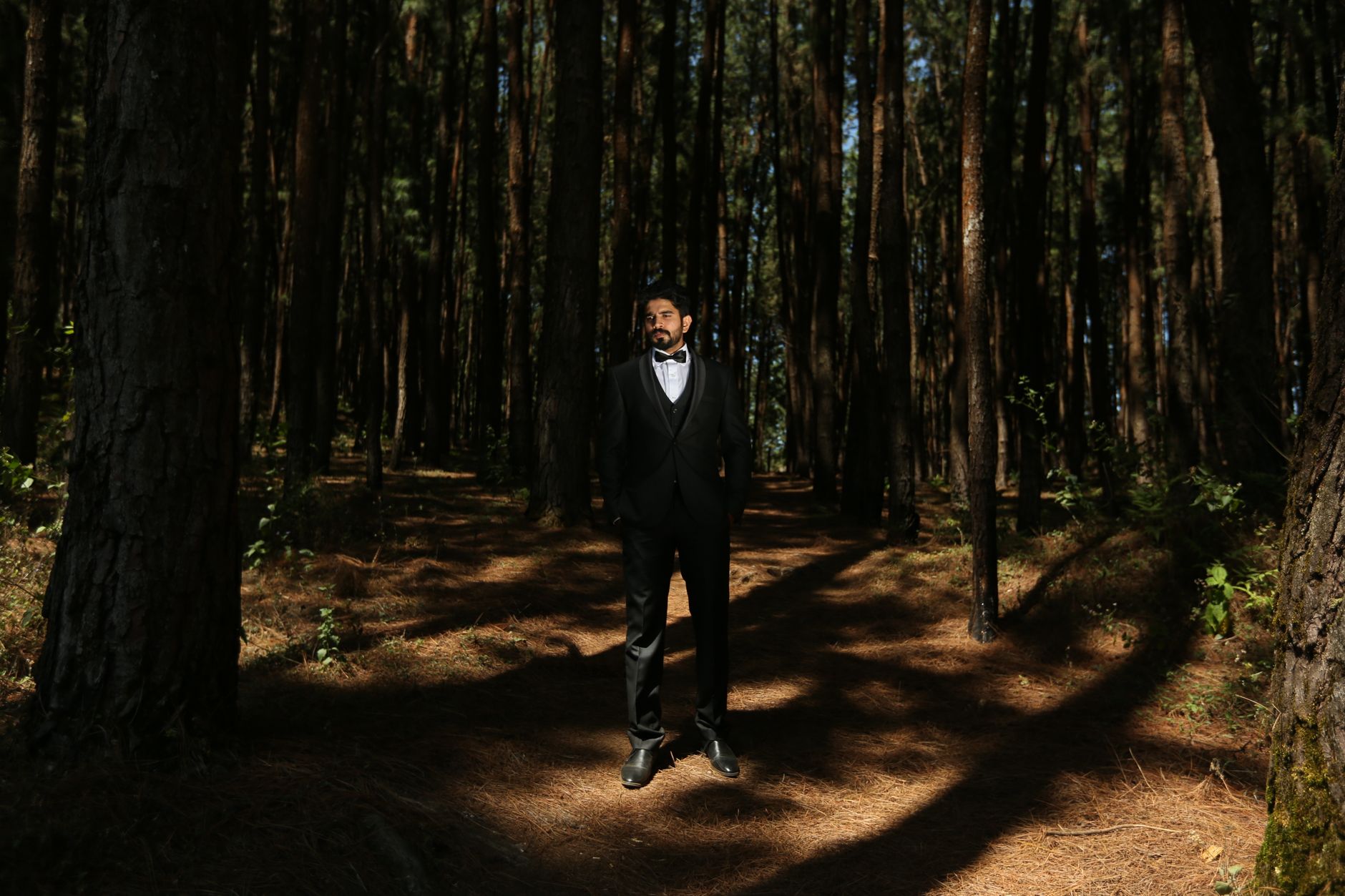
The parts that make a tuxedo a tuxedo
- Jacket: almost always a single button, with peak or shawl lapels faced in satin or ribbed grosgrain silk. Black or midnight blue. Notch lapels exist but read as the least formal option.
- Trousers: no belt loops, no cuffs, a satin stripe down the outer seam, held up by side adjusters or braces.
- Shirt: white, with a pleated or pique bib, and a placket that takes removable studs rather than plain buttons.
- Neckwear: a black bow tie in silk, satin or twill. A long tie with a tuxedo is a costume, not black tie.
- Waist covering: a cummerbund or a low-cut evening waistcoat. The waistband is never left bare.
- Shoes: black patent leather pumps or highly polished oxfords.
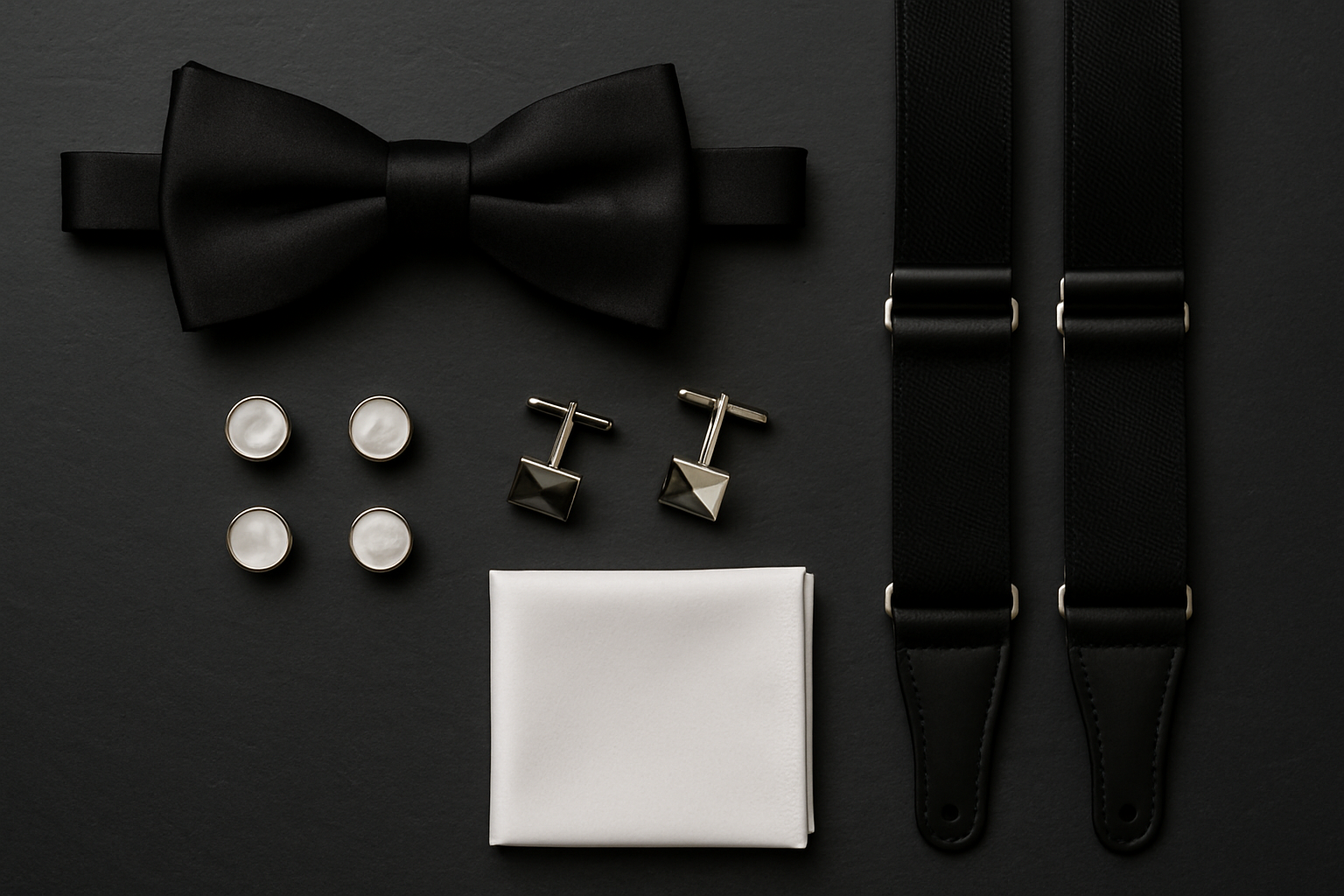
The Emily Post Institute’s black tie guide lists exactly that kit, and it includes “dressy braces” in the list of what a man wears under the jacket. That is not decoration. Formal trousers are built without belt loops, so something has to hold the line clean.
What is a suit?
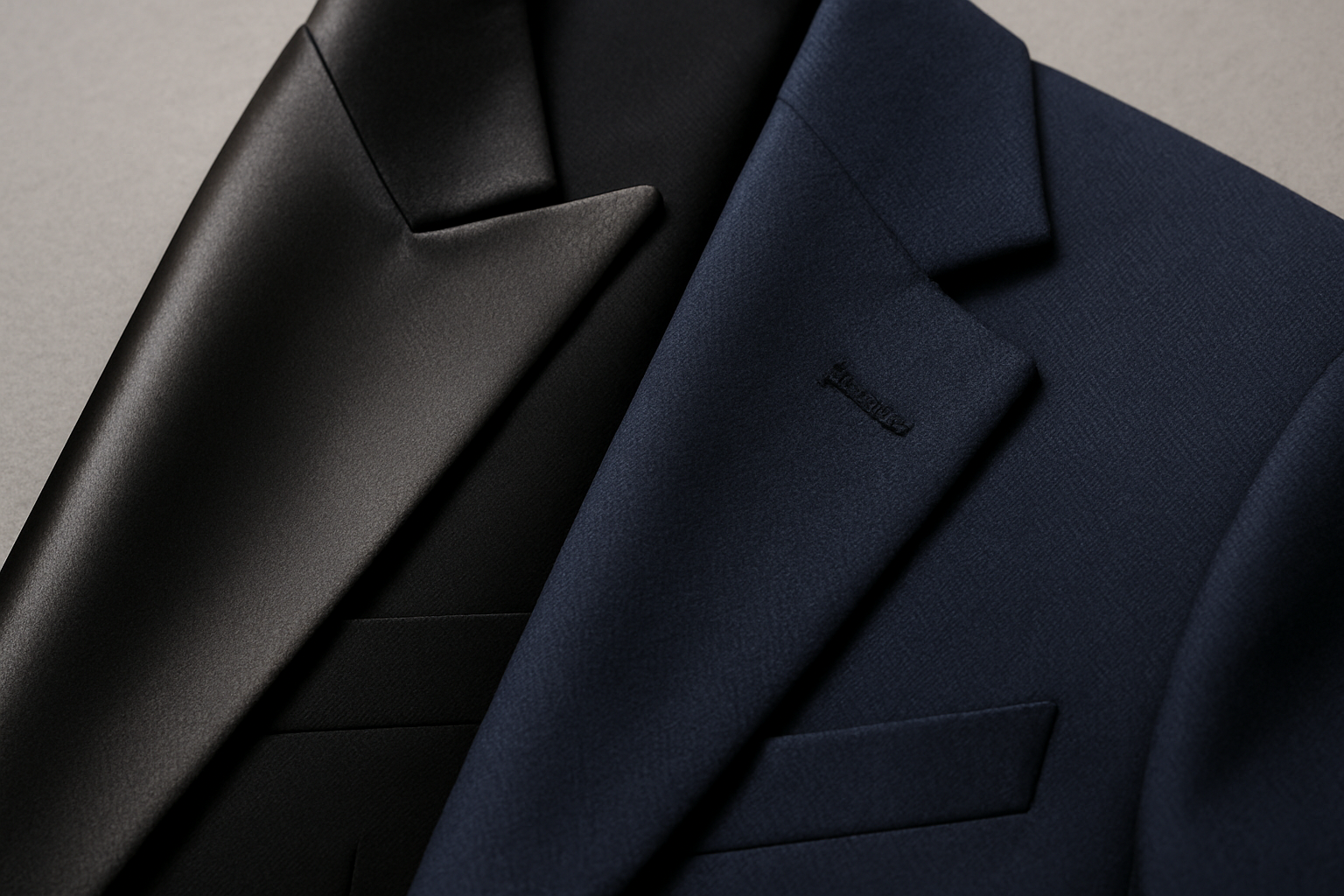
A suit is a jacket and trousers cut from one length of the same cloth, with every visible detail made from that cloth rather than contrast silk. Add a matching waistcoat and it becomes a three-piece. That single-cloth rule is what makes a suit a suit, whether it is navy worsted, grey flannel or tan cotton.
A suit is the most flexible garment in a man’s wardrobe because its formality is adjustable. Navy with a tie and oxfords reads boardroom. The same jacket over a knit polo reads Saturday dinner. A tuxedo has exactly one setting.

The parts that make a suit a suit
- Jacket: two buttons most often, notch lapels most often, in any colour from charcoal to check tweed.
- Buttons: horn, corozo, plastic or metal, never satin-wrapped.
- Trousers: belt loops as standard, cuffs optional, no side stripe.
- Shirt: any dress shirt with a standard turndown collar and ordinary buttons.
- Neckwear: a long tie, a knit tie, a bow tie for creative dress codes, or nothing at all.
- Shoes: oxfords, derbies, loafers or boots in black or brown leather.
Tuxedo vs suit: the key differences
The differences cluster in five places: fabric and lapels, buttons, trousers, shirt and accessories, and the hour of the day each one belongs to. Here is the whole comparison in one table.
| Feature | Tuxedo | Suit |
|---|---|---|
| Lapels | Satin or grosgrain faced, peak or shawl | Self-fabric, usually notch |
| Buttons | Satin covered, usually one on the jacket | Horn, corozo or plastic, one to three |
| Trousers | Satin side stripe, no belt loops, no cuffs | No stripe, belt loops, cuffs optional |
| Cloth | Fine wool or mohair blend in black or midnight blue | Worsted, flannel, linen, cotton, tweed in any colour |
| Shirt | White formal shirt, pleated or pique bib, studs | Any dress shirt, ordinary buttons |
| Neckwear | Bow tie | Long tie or open collar |
| Waist | Cummerbund or evening waistcoat, braces under the jacket | Belt, braces or side adjusters |
| Shoes | Patent leather or mirror-polished black | Any polished leather dress shoe |
| Time of day | Evening, traditionally after 6pm | Any hour |
| Formality | Black tie, one rung below white tie | Business through semi-formal |
Fabric and lapels: the tell you can spot across a room
Satin is the giveaway. Tuxedo lapels are faced in silk satin or ribbed grosgrain so they catch light under a chandelier, while suit lapels are cut from the jacket cloth and vanish into it. Tuxedo cloth is finer too, often a wool and mohair blend with a faint sheen, where suiting runs matte.
Buttons and closure
A tuxedo jacket is usually one-button single-breasted or six-on-two double-breasted, with buttons wrapped in the same satin as the lapels. Suits use horn or plastic buttons, commonly two. One button reads evening. Three read office.
Trousers and why braces matter
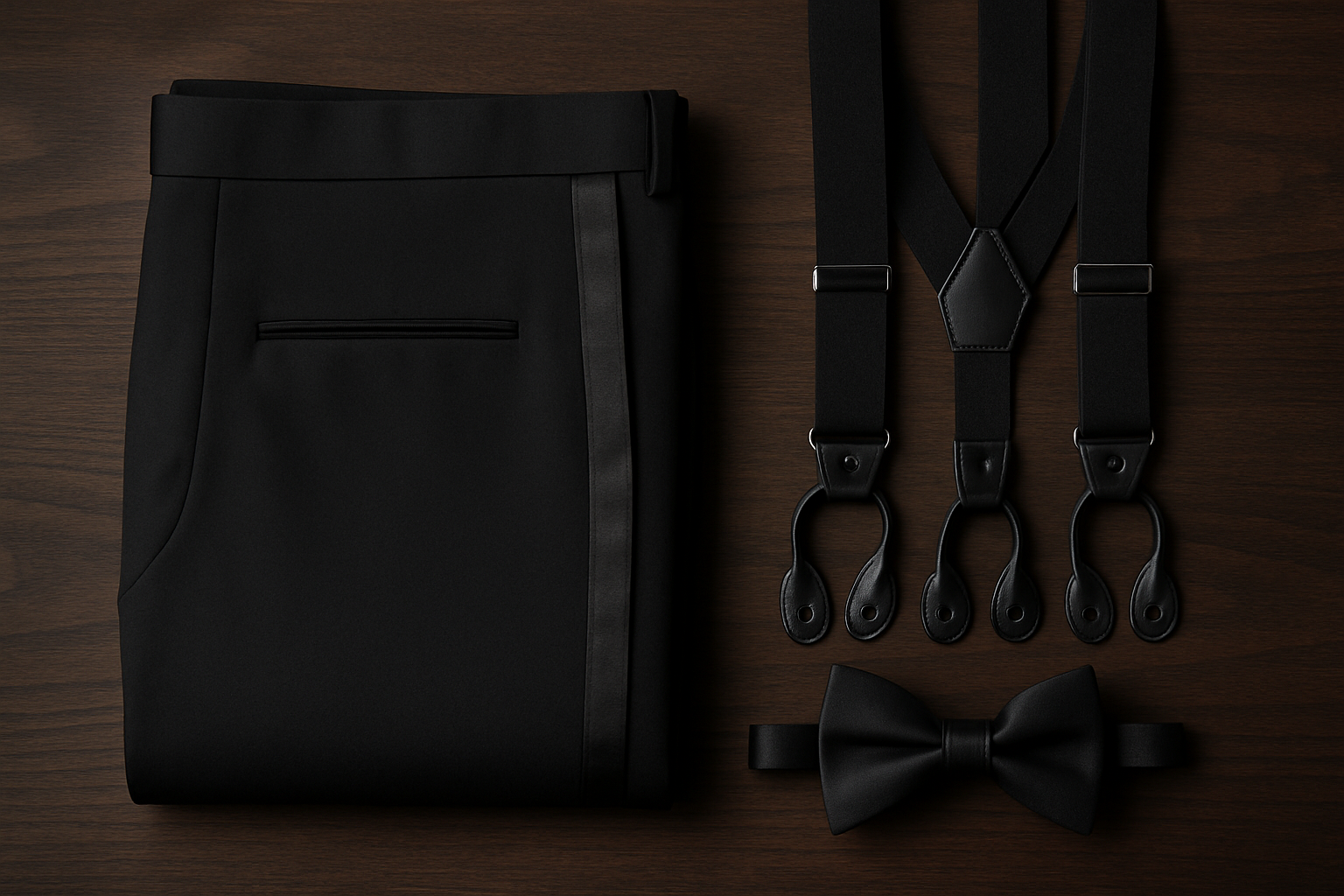
Tuxedo trousers are the detail most men get wrong. They carry a satin braid down the outer seam and they are made without belt loops on purpose, so the answer to the belt question is no. Formalwear specialists at Generation Tux put it plainly: if there are no loops, the trousers are designed for side adjusters or braces instead.
That is why black satin or barathea braces are standard black tie equipment. They hold a high-rise trouser at the natural waist so the cummerbund covers the join and nothing pulls when you sit. Our guide to wearing suspenders correctly covers strap length and the clip-versus-button decision. For formal trousers, button-on braces win, and this article on X-back construction explains why that shape sits flattest under a fitted jacket.
Shirt, accessories and shoes
A tuxedo shirt is a specific garment: white, bibbed, fastened with studs, finished with French cuffs and cufflinks. A suit shirt is whatever dress shirt you own. The accessory list splits the same way, and this is where most rental mistakes happen.
- Tuxedo: bow tie, studs, cufflinks, cummerbund or waistcoat, pocket square, black braces, patent shoes, black silk socks.
- Suit: necktie, belt or braces, pocket square optional, leather shoes and matching leather belt.
When to wear a tuxedo
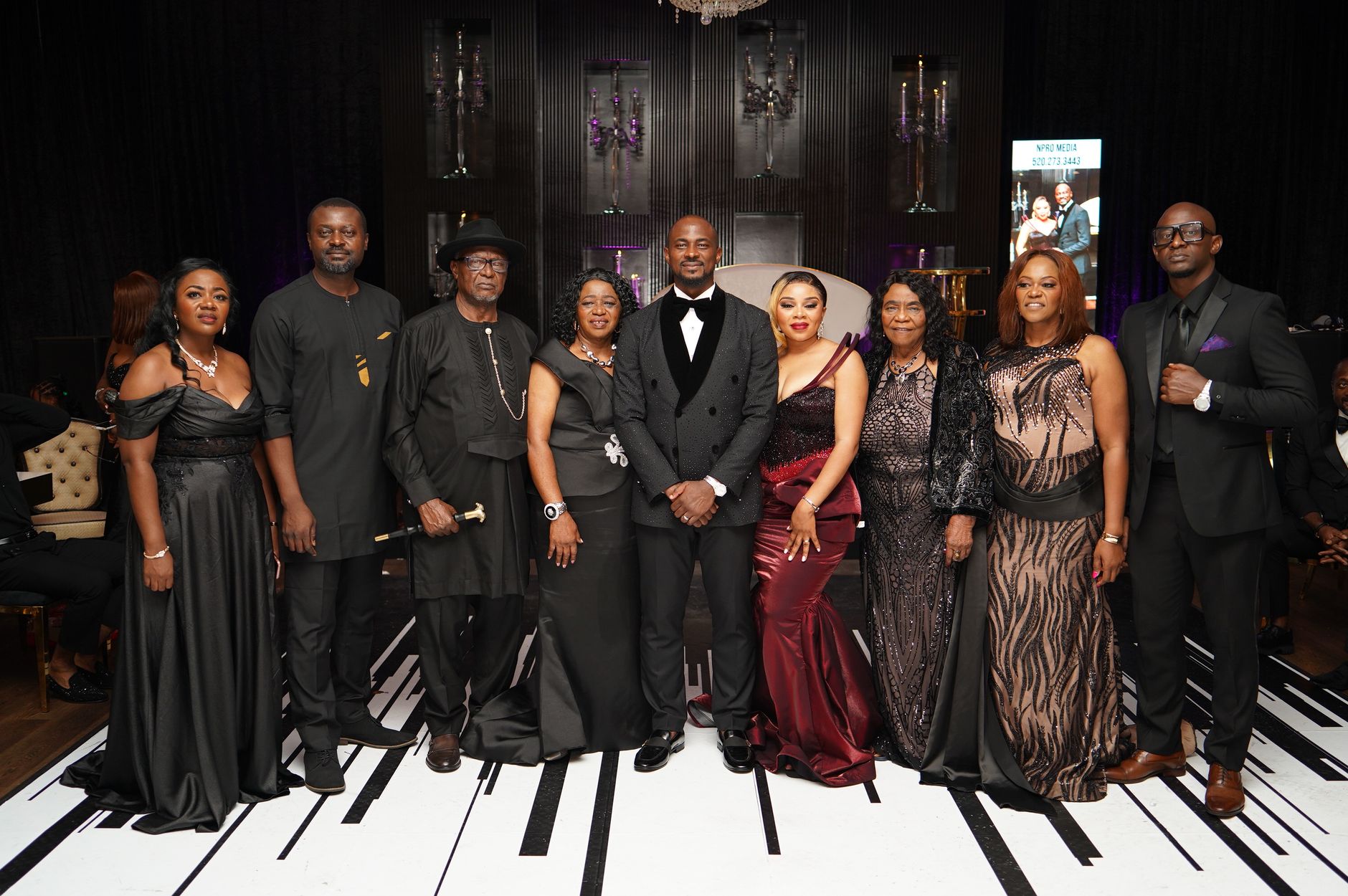
Wear a tuxedo when the invitation says black tie, black tie optional, formal or creative black tie, and when the event starts in the evening. Those five words are the whole trigger list. If none of them appear, a tuxedo will overdress the room.
- Black tie weddings and receptions, almost always with a start time after 5 or 6pm.
- Galas, charity balls and awards dinners, where the host has set the tone in writing.
- Opera and theatre openings and formal New Year celebrations.
- Prom and graduation balls, the first tuxedo most men ever wear.
- Cruise formal nights, where a white dinner jacket with black tuxedo trousers is the warm-weather version, exactly as Emily Post’s attire guide describes.
Two limits still hold. A tuxedo is evening wear, so before six the correct formal garment is a morning suit or a dark lounge suit. And black tie optional genuinely means optional: a dark suit with a conservative tie is a correct answer, not a compromise.
When to wear a suit
Wear a suit for everything that is not black tie, which is roughly ninety percent of the occasions a man dresses up for. Work, interviews, daytime weddings, funerals, court, christenings, dinners, graduations and most parties all sit in suit territory.
| Occasion | Best choice | Why |
|---|---|---|
| Job interview | Navy or charcoal suit | Neutral, serious, never memorable for the wrong reason |
| Daytime wedding | Mid-grey, blue or tan suit | Daylight kills black; lighter cloth photographs better |
| Funeral | Charcoal or black suit | Sombre without theatrics |
| Cocktail dress code | Dark suit, optional tie | Formal enough, flexible on neckwear |
| Black tie optional | Dark suit or tuxedo | Both are correct; the tuxedo is the higher note |
The suit is also where personality is allowed. Texture, colour and accessories shift a single jacket across half a dozen dress codes, and braces do a lot of that work. A patterned pair under a waistcoat adds interest without breaking any rule, and we covered the mechanics of that in our piece on wearing a suit with suspenders.

Tuxedo vs suit for weddings
For weddings, the couple’s stated dress code decides it, and if no dress code is given, the start time and venue decide it. Evening reception in a ballroom or hotel: tuxedo. Afternoon ceremony in a garden, barn, vineyard or beach: suit.
For the groom
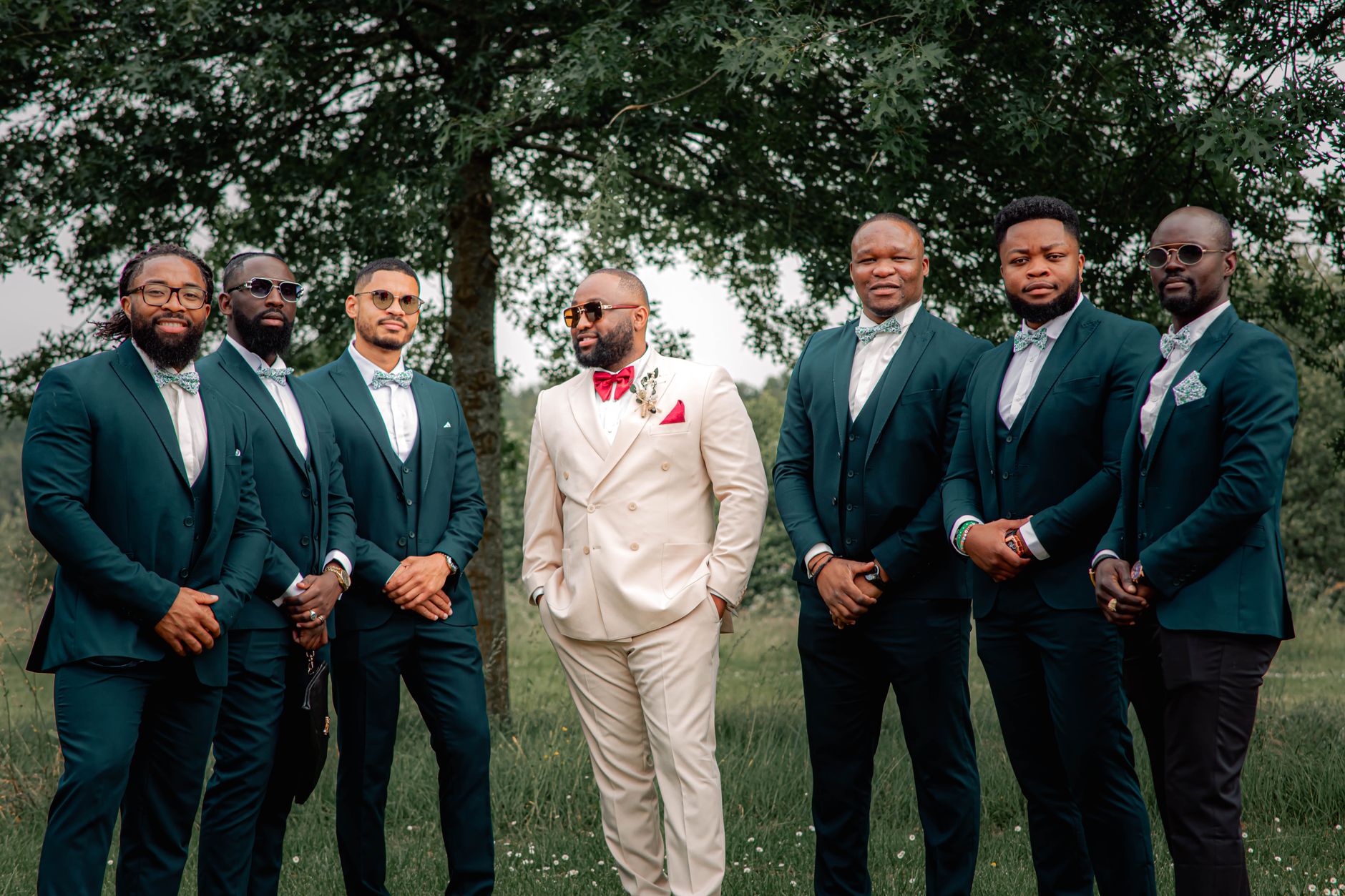
A groom can wear a tuxedo at an evening wedding even when guests are in suits, because the couple set the formality. What a groom should not do is wear a tuxedo at a 1pm outdoor ceremony. Midnight blue photographs richer than black under artificial light, which is why so many grooms choose it.
For groomsmen
Groomsmen follow the groom one step down or match him exactly. A common, cost-effective structure is a tuxedo for the groom and matching dark suits for the party, unified with identical accessories. Coordinated braces and bow ties are the cheapest way to make a mixed group look intentional, which is the approach we recommend in our rundown of what men should wear to a wedding.
For guests
Guests should not wear a tuxedo unless the invitation asks for black tie. Overdressing at someone else’s wedding pulls focus, and a charcoal or navy suit is correct at nearly every wedding. For colours, patterns and seasonal cloth, see our wedding outfit ideas.
Price comparison: what each one really costs
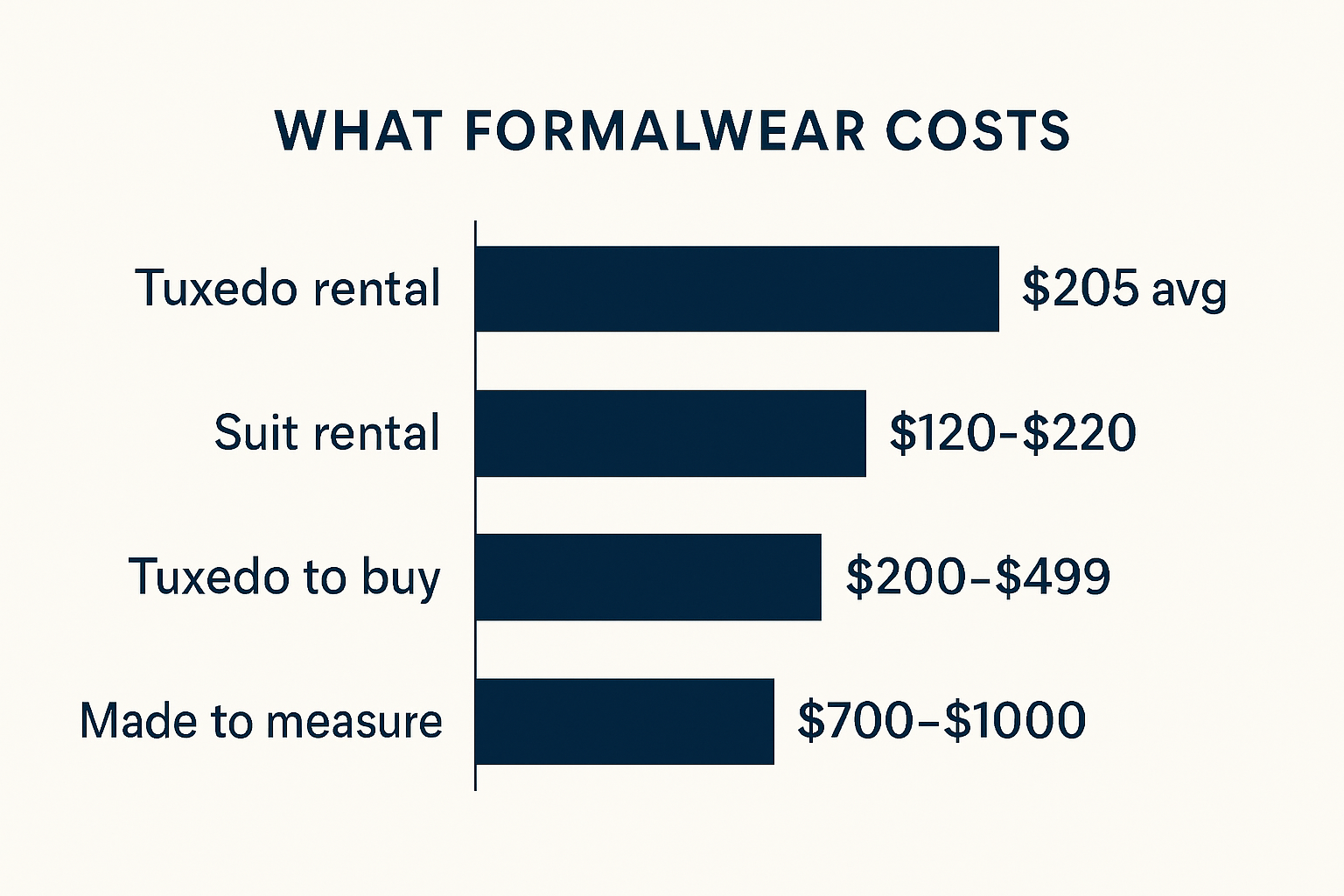
A tuxedo costs more than a comparable suit at every tier, typically by $100 to $300, because of the silk facings and the extra pieces the outfit requires. The Knot’s 2025 Real Weddings Study puts the average rental for a male partner’s ceremony attire at $205, as reported in The Knot’s tux rental cost guide.
| Option | Typical US price | Notes |
|---|---|---|
| Tuxedo rental | $150 to $300 | Average $205 per The Knot 2025 Real Weddings Study; usually includes shirt and shoes |
| Suit rental | $120 to $220 | Cheaper, but fit is still off the rack |
| Entry-level suit to buy | From about $200 | The Knot puts entry suits near $200 and entry tuxedos near $300 |
| Quality three-piece suit | $300 to $800 | Wears for years across dozens of occasions |
| Tuxedo to buy | $200 to $499 average | WeddingWire’s cost data for grooms buying formalwear |
| Made-to-measure tuxedo | $700 to $1,000 | Fit you cannot rent |
| Alterations | $50 to $150 | Add to every purchase; the single best money spent |
| Accessories | $30 to $120 | Braces, bow tie, studs, pocket square |
Rent or buy?
The maths is simple. At roughly $205 a rental, three formal events cost about $615, which buys a tuxedo you own and a tailor’s fee on top. According to WeddingWire’s wedding tuxedo cost guide, the average groom spends around $350 on attire overall, and buying in the $200 to $499 band puts an owned tuxedo inside that budget.
- Rent if this is a one-off, if your size is changing, or if you need a matched group look fast.
- Buy if you attend two or more formal events a year, or if you are between standard sizes and fit matters to you.
- Buy the accessories either way. Rental studs, bow ties and braces are the weakest part of any package, and a set you own costs less than one rental upgrade.
Tuxedo vs suit vs blazer vs smoking
A blazer is a standalone jacket with no matching trousers, a suit jacket always has matching trousers, a tuxedo is a suit with satin detailing, and a smoking is simply the French and wider European word for a tuxedo. Formality runs blazer, suit, tuxedo, tailcoat, in that order.
| Garment | What it is | Formality |
|---|---|---|
| Blazer or sport coat | Odd jacket worn with contrasting trousers | Smart casual to business casual |
| Suit | Jacket and trousers in one cloth | Business to semi-formal |
| Tuxedo / dinner jacket / smoking | Evening suit with satin facings | Black tie |
| Tailcoat | Cutaway evening coat with white tie | White tie, the highest code |
The British say dinner jacket, Americans say tuxedo, the French say un smoking, a clipped borrowing from the Victorian smoking jacket. Three names, one garment. The original smoking jacket, a velvet house robe from the 1850s, is a different thing and belongs at home.
What about women’s tuxedos?
A women’s tuxedo follows the same construction rules, satin lapels, satin buttons and a striped trouser, tailored to a female cut, and it is fully correct black tie dress. Yves Saint Laurent’s 1966 Le Smoking made it a permanent part of formal wardrobes.
How to choose between them
Run four questions in order and the decision makes itself. Dress code, start time, venue, then how often you will wear it again.
- Read the invitation. Black tie, formal or black tie optional means tuxedo. Cocktail, semi-formal, festive or nothing stated means suit.
- Check the clock. Before 6pm, choose the suit. Evening events carry a tuxedo comfortably.
- Look at the venue. Ballrooms, hotels and historic halls support satin. Beaches, barns and gardens fight it.
- Count future wears. One event a decade means rent. Two or more a year means buy, and buy the suit first if you only own one.
- Fit beats price. A $250 suit that is tailored outranks a $900 tuxedo that is not. Budget for alterations before you budget for upgrades.
Then finish it properly. The waistband is where cheap outfits give themselves away, and good braces fix trouser drape instantly. Our notes on what separates premium braces from cheap ones cover elastic quality, hardware and leather ends.
Ready to sort the last detail? Browse the full range of suspender types at Trend Suspenders and pick a formal pair for black tie plus a patterned pair for everyday suits. Both ship from the same order.
Key takeaways
- A tuxedo is a suit with satin lapels, satin buttons and a satin trouser stripe, built for evening formal wear.
- A suit uses one cloth throughout and works from morning to midnight across almost every dress code.
- Black tie on the invitation is the only reliable signal that you need a tuxedo.
- Tuxedo trousers have no belt loops, so braces or side adjusters are part of the outfit, not an accessory.
- Rentals average $205 per person; three rentals cost more than owning a decent tuxedo outright.
- For weddings, the couple’s dress code, the start time and the venue decide it, in that order.
- Blazer, suit, tuxedo, tailcoat is the formality ladder; smoking and dinner jacket are just other words for tuxedo.
People also ask
Is a suit and tuxedo the same?
No. A tuxedo is a subcategory of suit with satin or grosgrain facings on the lapels, satin-covered buttons and a satin stripe on the trousers, and it is reserved for evening formal wear. A standard suit uses the same matte cloth for every part and covers business and semi-formal occasions.
Can I wear a suit as a tuxedo?
You can wear a dark suit where black tie is optional, but you cannot turn a suit into a tuxedo. A midnight blue or charcoal suit with a white formal shirt, a black bow tie and polished black shoes is a respectable near-miss that reads correct in photographs. At a strict black tie event, the missing satin will be noticed by anyone who owns a tuxedo.
Is a tuxedo fancier than a suit?
Yes. A tuxedo sits one rung below white tie on the formality ladder and above every suit, which is why it appears only at evening events with a stated dress code. Wearing one to an occasion that calls for a suit overdresses you rather than impressing anyone.
Is a tux just a black suit?
No, though from across a room they look similar. A black suit is matte from lapel to hem, while a tuxedo carries silk satin or grosgrain at three fixed points: the lapels, the buttons and the outer trouser seam. Many tuxedos are also midnight blue rather than black, because blue reads darker than black under artificial light.
Do you wear suspenders or a belt with a tuxedo?
Suspenders. Tuxedo trousers are made without belt loops so the waistline stays clean under a cummerbund, and Emily Post’s black tie guidance lists dressy braces as part of the outfit. Choose black silk or barathea with button attachments rather than metal clips.
What is the difference between a tuxedo and a smoking?
None, in practice. Smoking is the French and continental European word for the same garment Americans call a tuxedo and the British call a dinner jacket. The word comes from the Victorian smoking jacket, which is a separate velvet house garment.
Can you wear a tuxedo during the day?
Traditionally no. Black tie is evening dress, so daytime formal occasions call for a morning suit in the strictest settings or a dark lounge suit everywhere else. Noon weddings that state black tie are an exception created by the couple, and in that case follow the invitation.
Watch or listen Tuxedo vs Suit: The Satin Rule That Settles It
A 7-minute conversation from Over the Shoulder: The Trend Suspenders Show.
Follow the show on Spotify · Apple Podcasts · Amazon Music · iHeartRadio


